By the Faucon IMC Business Setup & Accounting Team — Faucon International Management Consultancy, established in 2018, bringing 8 years of hands-on UAE payroll, accounting, and compliance experience Last updated: July 2026
Introduction
Accounting consultancy services are what separate businesses that grow with confidence from businesses that spend every quarter putting out compliance fires. Dubai and the wider UAE offer one of the most business-friendly environments anywhere in the world, but the regulatory side has grown up fast — VAT, corporate tax, Economic Substance Regulations, UBO reporting, WPS payroll. None of it is optional, and none of it forgives guesswork.
At FAUCONIMC, we sit down with business owners every week who are managing all of this through a part-time bookkeeper and a shared spreadsheet — and the moment something slips, it’s usually an FTA penalty or a missed licence renewal that finally forces the conversation. What usually happens next follows a predictable pattern: the owner scrambles to reconstruct months of records, pays a penalty that could have been avoided, and only then starts asking what a proper accounting consultancy actually looks like.
This guide walks through exactly what accounting consultancy services should cover, how UAE compliance has evolved over the past several years, what it actually costs to get this right, and how to choose a firm that will genuinely protect your business rather than just process your paperwork once a quarter. Whether you’re a founder setting up your first free zone company, an SME owner who’s outgrown a part-time bookkeeper, or a finance lead managing multiple UAE entities, the fundamentals below apply to you.

Why Accounting Consultancy Services Matter More Than Ever in the UAE
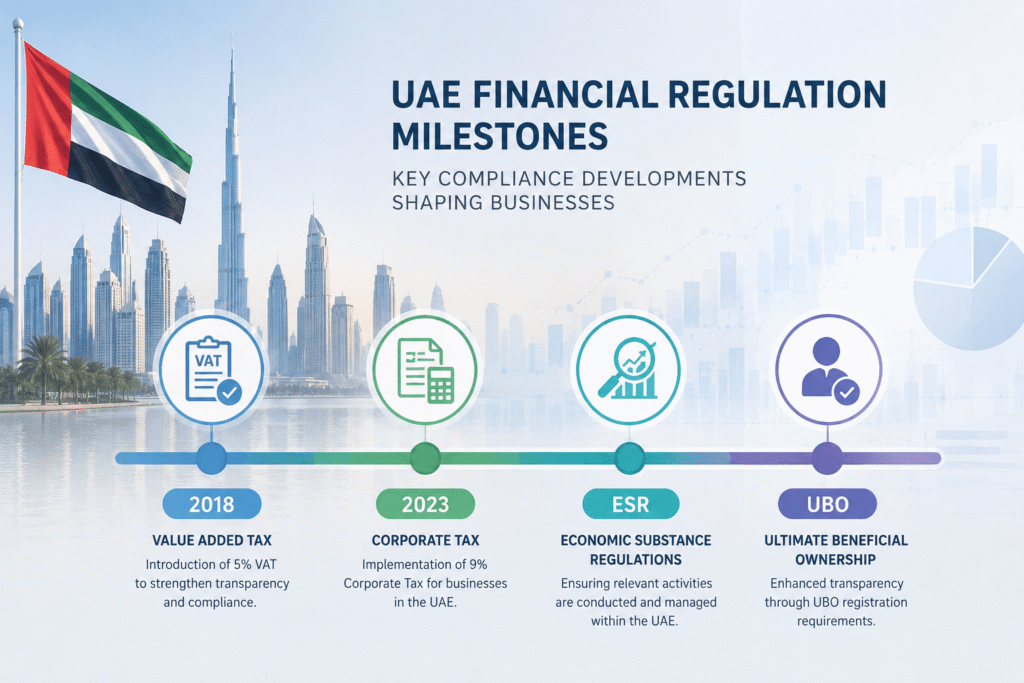
A decade ago, the UAE was one of the most tax-free environments in the world. That’s changed quickly, and the pace of new compliance requirements has caught plenty of businesses off guard:
- 2018: VAT introduced at 5%, with mandatory registration above AED 375,000 in taxable turnover
- 2020: Economic Substance Regulations (ESR) came into effect
- 2022: Ultimate Beneficial Ownership (UBO) reporting requirements tightened
- 2023: UAE Corporate Tax at 9% became effective for financial years starting June 2023 onwards
Each layer adds its own filing calendar, its own documentation, and its own penalty regime if missed. You can check current VAT and corporate tax rules directly with the Federal Tax Authority — penalties for late VAT registration, incorrect filings, or missed corporate tax deadlines can run into tens of thousands of dirhams. This is exactly why accounting consultancy services have moved from a “nice to have” to a genuine necessity for any UAE business, regardless of size.
What makes this genuinely difficult for business owners isn’t any single requirement in isolation — VAT registration on its own is manageable, and so is a single corporate tax filing. The difficulty is that these obligations overlap, run on different calendars, and require different documentation, and a business trying to track all of it manually will eventually miss something. A consultancy that treats each requirement as a connected system, rather than four separate boxes to tick, is what actually keeps a business out of trouble year after year.
There’s also a strategic dimension that often gets missed. Corporate tax registration, for instance, isn’t just a compliance formality — it’s an opportunity to review your entity structure, confirm whether you qualify for the 0% free zone rate on qualifying income, and plan your tax position within the law rather than reacting to it after the fact. Businesses that bring in accounting consultancy support early, before a deadline is looming, generally end up with a cleaner, more defensible position than those who call a firm the week a filing is due.
What Do Professional Accounting Consultancy Services Actually Cover?
Not every firm offering accounting consultancy services in Dubai covers the same ground. Here’s what a genuinely complete provider should handle.
Bookkeeping Services UAE
Bookkeeping is the foundation everything else depends on — every sale, purchase, expense, and bank transfer recorded accurately and on time. Modern bookkeeping runs on cloud platforms like Xero, QuickBooks, or Zoho Books, keeping your records audit-ready at any moment rather than reconstructed under pressure at year-end. Our own accounting services team builds every engagement on this cloud-first foundation before anything else is layered on top.
For businesses with multiple bank accounts, foreign currency transactions, or inventory to track, bookkeeping quality compounds over time — a small reconciliation error left unresolved in month one becomes a much bigger problem to unwind by month twelve. This is one of the main reasons monthly reconciliation, rather than an annual clean-up, has become the standard expectation for any serious accounting consultancy engagement
VAT Services Dubai
Since VAT was introduced in January 2018, managing compliance has become one of the more time-consuming parts of running a UAE business. VAT services typically include:
- VAT registration with the FTA
- Preparation and filing of VAT returns (quarterly or monthly)
- Input and output tax reconciliation
- FTA audit support and correspondence
- VAT refund applications where applicable
Corporate Tax Services Dubai
The UAE’s 9% corporate tax on profits above AED 375,000 has applied since June 2023, and for many businesses it was the first time corporate tax entered the picture at all. Our USA and UAE tax services team handles registration, taxable income assessment, annual return filing, transfer pricing documentation, and legitimate tax planning within the law.
Payroll Services Dubai
UAE payroll runs through the Wage Protection System (WPS), with end-of-service gratuity, annual leave accruals, and sector-specific labour rules layered on top. Outsourcing this removes a lot of the risk that comes with getting it wrong.
Payroll Services Dubai
UAE payroll runs through the Wage Protection System (WPS), with end-of-service gratuity, annual leave accruals, and sector-specific labour rules layered on top. Salaries must be transferred through a WPS-registered channel within the required timeframe, and repeated late or incorrect transfers can affect a company’s WPS compliance rating — which in turn can affect visa processing and other government services tied to the business. Outsourcing payroll to a team that runs this daily, rather than a bookkeeper handling it as a side task, removes a lot of the risk that comes with getting it wrong.
Financial Consultancy UAE
Beyond compliance, financial consultancy covers IFRS-standard financial statements, management reporting and KPI dashboards, cash flow forecasting, business valuation support, and CFO-level advisory for businesses that aren’t ready for a full-time finance director.
Outsourced Accounting Services Dubai
Outsourcing your finance function gives you a full team — bookkeepers, tax specialists, financial advisors — at a fraction of the cost of building the same bench in-house. It’s become the default choice for SMEs and startups that want enterprise-level expertise without enterprise-level payroll.
ESR and UBO Compliance Support
Economic Substance Regulations and Ultimate Beneficial Ownership reporting are two of the quieter compliance obligations — they don’t come with the same visibility as a VAT return, but the penalties for missing a notification or filing deadline are real. A good accounting consultancy tracks these alongside your VAT and corporate tax calendar so a UBO update or an ESR notification never gets missed simply because nobody was watching that specific date.
What to Look For: Basic Bookkeeping vs Full Accounting Consultancy
| Feature | Basic Bookkeeping Provider | Full Accounting Consultancy Firm |
|---|---|---|
| Bookkeeping | Manual, monthly | Cloud-based, real-time |
| VAT & Corporate Tax | Filing only | Filing plus proactive tax planning |
| Payroll | Manual processing | WPS-compliant, automated |
| Free Zone/Mainland Nuance | Generic approach | Structure-specific compliance |
| Advisory | None | CFO-level financial guidance |
| Point of Contact | Rotating staff | Dedicated account manager |
When comparing firms, prioritise industry experience relevant to your sector, ACCA/CPA/CA-qualified professionals actually assigned to your account, cloud-based technology, transparent fixed-fee pricing, and genuine responsiveness — test how quickly a firm answers your first enquiry, because that usually predicts how they’ll behave once you’re a paying client.
It’s worth noting that the gap between these two columns rarely shows up on day one. A basic provider can look perfectly adequate for the first few months, right up until a VAT deadline is missed, a free zone audit request lands with two weeks’ notice, or a bank asks for management accounts nobody has been preparing. The difference becomes visible exactly when you can least afford it — which is why it’s worth evaluating a provider on the second column’s criteria before you sign, not after something goes wrong.
Services and Specializations
FAUCONIMC’s accounting consultancy services are built around dual UAE-US tax expertise, cloud-first delivery, and a dedicated account manager for every client, so you’re never re-explaining your business to a new face each quarter. Alongside core accounting and tax work, our team also supports clients through business setup and auditing and assurance, covering you from incorporation through to your first audited financial statements.
The Process
1.Discovery call — reviewing your entity structure, free zone or mainland status, and current bookkeeping setup, including where the gaps in your existing records are
2.Cloud migration — moving historical records onto a platform like Xero or QuickBooks, with a clean-up of any backlog before the monthly cycle begins
3.Monthly cycle — bookkeeping, reconciliation, and management reporting on a fixed schedule, so you receive the same reports on the same date every month
4.Compliance calendar — VAT returns, corporate tax filings, ESR notifications, and UBO updates tracked against FTA and free zone deadlines, with reminders built in well ahead of each date
5.Quarterly or annual review — financial statements prepared for licence renewal, banking, or investor requirements, plus a check-in on whether your entity structure and tax position still fit how the business has grown
Cost of Accounting Consultancy Services in Dubai and UAE
- Basic bookkeeping (small business): AED 500–2,000/month
- VAT return filing: AED 500–1,500 per return
- Corporate tax registration and first return: AED 2,000–5,000
- Full outsourced accounting package: AED 2,500–8,000+/month
- Annual audit and financial statements: AED 3,000–15,000+, depending on complexity
The cost of getting it wrong — FTA penalties, missed renewals, decisions made on incomplete numbers — is almost always higher than the fee of getting it right from the start.
Most of the price variation between firms comes down to how much is bundled into the monthly fee versus billed separately. A quote that looks unusually low often excludes things like FTA correspondence, payroll processing, or year-end financial statement preparation — all of which get billed as extras later. When comparing proposals, ask specifically what happens if the FTA sends a query, if you add a new employee mid-year, or if your free zone requests an audit ahead of the usual schedule. A transparent firm will have a clear answer to all three before you sign anything.
Legal Requirements in UAE
All UAE businesses must maintain proper financial records for a minimum of five years under the Commercial Companies Law. VAT-registered businesses must file returns with the FTA on their assigned schedule, and businesses subject to corporate tax must file annual returns. Free zone companies — DMCC, JAFZA, IFZA, DIFC among others — typically require annually audited financial statements as part of licence renewal, with specifics varying by authority. Qualifying free zone businesses may also benefit from a 0% corporate tax rate on qualifying income if conditions are met. You can confirm current requirements on the UAE Government’s official portal.
Best Practices
- Build a single compliance calendar covering VAT, corporate tax, ESR, UBO, and licence renewal dates
- Move to cloud accounting before a deadline forces the decision, not after
- Reconcile bank accounts monthly rather than waiting for year-end
- Confirm, by name and qualification, exactly who will handle your account
- Review management accounts quarterly against your original budget
Benefits of Working With an Accounting Consultancy
- Predictable monthly cost versus the expense of building an in-house finance team
- Access to ACCA/CPA-qualified professionals without a full-time salary commitment
- Reduced exposure across VAT, corporate tax, ESR, UBO, and WPS payroll
- Real-time visibility into cash flow and profitability
- Strategic guidance on business structure and growth, not just compliance filing
Common Challenges Dubai Businesses Face
- Treating VAT, corporate tax, ESR, and UBO as separate one-off tasks instead of one ongoing compliance calendar
- Free zone audit requirements catching businesses off guard at renewal time
- Payroll errors creating WPS violations or employee disputes
- Financial reports arriving too late to influence any real decision
- Confusing a bookkeeper with a consultant — one keeps the books, the other advises on the business
Case Study: From Reactive Filing to Proactive Planning
The following is an illustrative scenario reflecting a common client situation, not a specific named case.
Problem: A free-zone professional services company had registered for VAT and corporate tax but was handling each requirement separately through different part-time contractors, with no single compliance calendar. A UBO filing deadline was missed, triggering a formal notice from the relevant authority.
Solution: The business consolidated bookkeeping, VAT, corporate tax, and UBO/ESR compliance under one accounting consultancy team, who built a single tracked calendar and assigned one dedicated account manager as the point of contact.
Result: All subsequent filings were submitted ahead of deadline, the free zone audit for licence renewal was completed without last-minute scrambling, and the owner began receiving monthly management reports early enough in each cycle to actually act on them.
Expert Tips
- Don’t wait until your free zone renewal to think about audited financials — start at least two months ahead
- Keep VAT, corporate tax, ESR, and UBO filing history in one accessible record, not scattered across email threads
- Ask any prospective consultancy exactly who — by name and qualification — will handle your account monthly
- Reassess whether your free zone business still qualifies for the 0% corporate tax rate each year, as qualifying income conditions can change with your activities
Frequently Asked Questions
Q1: What accounting consultancy services are mandatory for businesses in the UAE?
All UAE businesses must maintain proper financial records for at least five years. VAT-registered businesses must file returns with the FTA, and businesses subject to corporate tax must file annual returns. Free zone companies typically need audited financial statements for licence renewal.
Q2: What’s the difference between an accountant and an accounting consultant?
An accountant handles day-to-day tasks — bookkeeping, payroll, VAT returns, and financial statements. A consultant adds strategic advice on top — tax planning, business structuring, and forecasting. The best firms in Dubai offer both.
Q3: How much do accounting consultancy services cost in Dubai?
Basic monthly bookkeeping starts around AED 500 for small businesses, while a full outsourced package covering bookkeeping, VAT, payroll, and reporting typically runs AED 2,500–8,000 per month, depending on scope.
Q4: Do free zone companies in Dubai need accounting consultancy services?
Yes. Most free zone authorities require annually audited financial statements for licence renewal, and free zone companies are subject to VAT and corporate tax obligations, with some qualifying for a 0% rate on qualifying income.
Q5: What is VAT in the UAE and how does it affect my business?
VAT was introduced in January 2018 at a standard rate of 5%. Businesses with taxable turnover above AED 375,000 must register with the FTA and file regular returns.
Q6: What is UAE corporate tax and who does it apply to?
A 9% federal corporate tax applies to business profits above AED 375,000, effective for financial years starting on or after 1 June 2023. Profits below the threshold are taxed at 0%, and qualifying free zone businesses may also access a 0% rate on qualifying income.
Q7: Can small businesses benefit from outsourced accounting services in Dubai?
Yes — outsourcing gives small and medium businesses a full team of qualified professionals at a predictable monthly cost, typically well below the cost of an in-house hire.
Q8: How do I choose the best accounting consultancy in Dubai for my business?
Look for verified industry experience, ACCA/CPA/CA-qualified staff actually working your account, cloud-based tools, transparent pricing, and a firm that responds quickly and consistently — not just once a quarter.
Conclusion
The UAE’s regulatory landscape — VAT, corporate tax, ESR, UBO, WPS payroll — has matured quickly, and businesses that treat accounting consultancy services as a strategic partnership rather than an annual scramble are the ones that scale with confidence. Whether you need bookkeeping, dual UAE-US tax expertise, payroll management, or CFO-level advisory, the right accounting consultancy firm in Dubai and the UAE turns compliance from a source of stress into a source of clarity.
Call to Action
Ready to bring structure and clarity to your accounting? Get in touch with the FAUCONIMC team today:
- Email: info@fauconimc.com
- WhatsApp (UAE): +971 50 791 7150
- WhatsApp (USA): +1 (818) 723-6166
- Website: fauconimc.com