Written by the advisory team at Faucon International Management Consultancy (Faucon IMC), a UAE accounting, tax, and business setup advisory firm serving startups, SMEs, and multinational businesses since 2018. Last updated: July 2026
Introduction
Business setup in Dubai mainland is one of the most searched topics among entrepreneurs who want to tap into the UAE’s fast-growing economy without the restrictions that come with free zone jurisdictions. Dubai has long positioned itself as a hub for trade, tourism, technology, and finance, and mainland companies are the only structures that allow a business to trade freely across the entire UAE market, not just within a designated zone. For investors coming from Europe, Asia, Africa, or elsewhere in the Middle East, this flexibility is often the single biggest reason they choose mainland over free zone incorporation.
Over the last few years, the Dubai Department of Economy and Tourism (DET), formerly known as the DED, has simplified licensing procedures considerably. Many activities now allow 100% foreign ownership without the need for a local Emirati sponsor, a change that has reshaped how investors think about mainland business setup Dubai. This article walks through everything a founder needs to know — the process, the real cost breakdown, legal requirements, common mistakes, and practical tips from professionals who handle these registrations every week. Having guided startups, SMEs, and multinational clients through UAE company formation for years, we’ve seen firsthand which decisions save founders time and money, and which ones create costly delays.

What Is Business Setup in Dubai Mainland?
A mainland company, also called an onshore company, is registered directly with the Dubai DET rather than with a free zone authority. This distinction matters because a mainland license lets a business operate anywhere in Dubai and the wider UAE, bid on government contracts, and open branches in other emirates without additional approvals. Free zone companies, by contrast, are generally restricted to operating within their zone or internationally, unless they appoint a local distributor for mainland trade.
For an SME that wants to sell products in Dubai malls, offer consulting services to local companies, or run a restaurant in a busy neighbourhood, mainland business setup in Dubai is usually the only realistic route. It’s also the preferred choice for firms that want maximum credibility with UAE banks, landlords, and government departments. If you’re weighing this decision alongside your tax and accounting setup, our Business Setup Services page covers how licensing and financial structuring work together from day one.
Mainland vs Free Zone: A Quick Comparison
| Factor | Mainland Company | Free Zone Company |
|---|---|---|
| Market access | Trade UAE-wide | Limited to zone / international |
| Ownership | Full foreign ownership (most activities) | Full foreign ownership (standard) |
| Office requirement | Physical office with Ejari mandatory | Flexi-desk often allowed |
| Government tenders | Eligible to bid | Generally not eligible |
| Local bank/client credibility | Typically stronger | Can be more limited |
Business Setup in Dubai Mainland: Step-by-Step Process
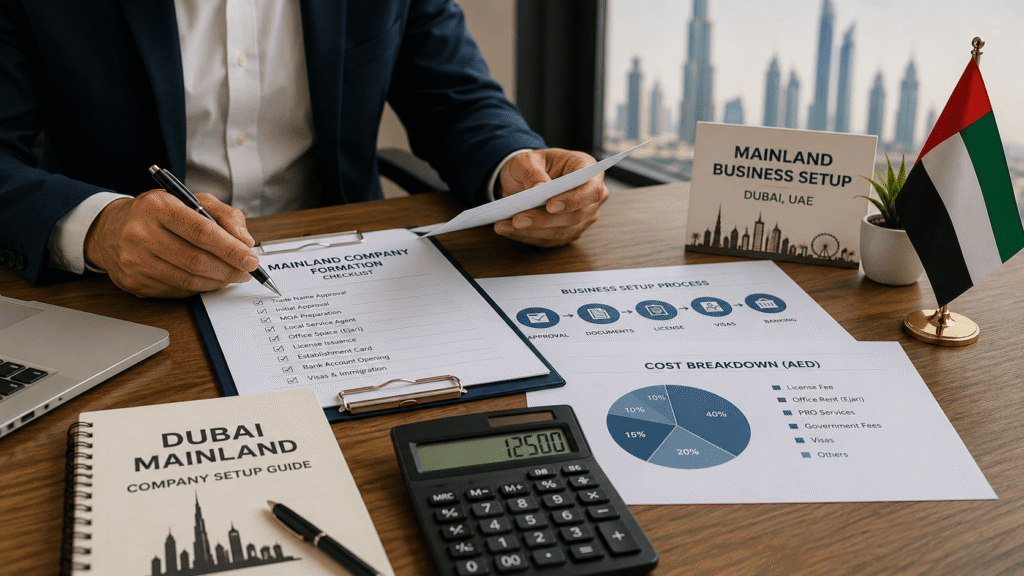
Understanding the process removes much of the anxiety that first-time founders feel. Here is how mainland business setup in Dubai typically unfolds from start to finish.
Step 1: Decide your business activity. Every license is tied to specific activities approved by the DET. The dubai mainland business activities list is extensive, covering trading, professional services, industrial operations, and tourism, among others. Choosing the right activity code at the start avoids costly amendments later, since changing activities after registration often triggers new approvals and fees. You can verify current activity codes directly on the Dubai Department of Economy and Tourism official portal.
Step 2: Choose a legal structure. Common structures include Limited Liability Company (LLC), Sole Establishment, Civil Company, and branch of a foreign company. An LLC remains the most popular choice for trading and general commercial businesses because it offers liability protection and now allows full foreign ownership in most sectors.
Step 3: Reserve a trade name. The trade name must comply with DET naming conventions — no offensive language, no reference to religious or political organisations, and no names that are already registered. Reservation is usually completed online within a day.
Step 4: Apply for initial approval. Initial approval confirms the government has no objection to the applicant starting the business, though it doesn’t yet authorise trading. At this stage, additional approvals may be required from other authorities depending on the activity — for example, healthcare businesses need Dubai Health Authority approval (see our DHA License Dubai guide for that process), while food businesses need Dubai Municipality sign-off.
Step 5: Draft the Memorandum of Association (MOA). The MOA is a legal document that outlines each shareholder’s ownership percentage, capital contribution, and profit-sharing ratios. This document is typically notarised through the Dubai Courts or an approved online notarisation platform.
Step 6: Secure office space and Ejari registration. A tenancy contract registered under Ejari is mandatory for most mainland licenses. Office size requirements vary by activity — a small consultancy may only need a modest workspace, while manufacturing or logistics companies require larger, activity-specific premises.
Step 7: Submit final documents and pay fees. Once all approvals, the MOA, and Ejari are in place, the final application is submitted to the DET along with the license fee. Upon approval, the trade license is issued, usually within a few working days.
Step 8: Open a corporate bank account. With the trade license in hand, the company can open a UAE corporate bank account, apply for the Emirates ID and residence visas for owners and staff, and begin operations. Getting your bookkeeping set up correctly from this first transaction onward makes tax registration and future audits far smoother — see our Accounting Services for how this is typically structured.
Dubai Mainland Business Setup Cost: What to Expect
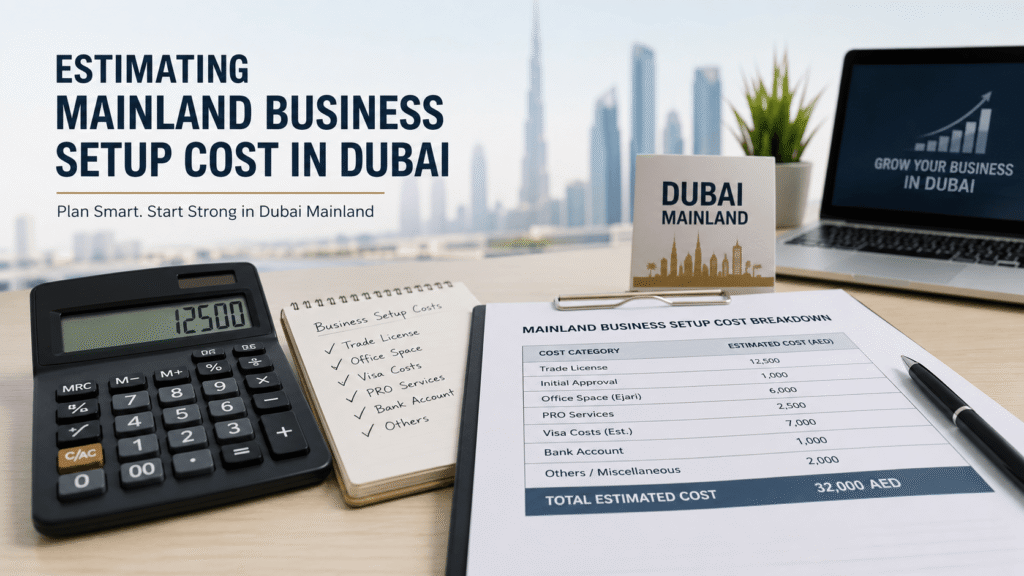
Dubai mainland business setup cost varies significantly depending on activity, office size, number of visas, and whether external approvals are needed. That said, founders should budget for the following typical components:
For a lean, single-shareholder consultancy, the Dubai business setup cost mainland route can be kept relatively modest by starting with a small office and minimal visas. Larger trading, industrial, or F&B operations naturally involve higher setup and mainland license Dubai cost due to bigger premises, more approvals, and additional government inspections. It’s worth getting a detailed, itemized quote from a licensed business setup consultant before committing, since bundled “packages” advertised online don’t always disclose every add-on fee.
- Trade license fee — charged annually by the DET, varying by activity type and number of activities selected
- Initial approval and name reservation fees — relatively small, fixed government charges
- Office rent and Ejari registration — often the largest single cost, since mainland licenses require a registered physical address
- MOA notarisation — a one-time cost during incorporation
- Visa costs — establishment card, Emirates ID, medical testing, and visa stamping for each employee or shareholder who needs residency
- Chamber of Commerce membership — usually required annually for mainland companies
- For a lean, single-shareholder consultancy, the Dubai business setup cost mainland route can be kept relatively modest by starting with a small office and minimal visas. Larger trading, industrial, or F&B operations naturally involve higher setup and mainland license Dubai cost due to bigger premises, more approvals, and additional government inspections. It’s worth getting a detailed, itemized quote from a licensed business setup consultant before committing, since bundled “packages” advertised online don’t always disclose every add-on fee.
Is Free Business Setup in Dubai Mainland Really Free?
Marketing terms like “free business setup in Dubai mainland” usually refer to consultants waiving their own service fee while government charges still apply. There is no scenario where a mainland license is issued without paying DET fees, Ejari registration, and other statutory costs. Treat “free setup” offers as a discount on consultancy fees, not a waiver of government dues, and always ask for a full cost breakdown in writing before signing anything.
Legal Requirements in UAE for Mainland Companies
Setting up legally isn’t just about getting a license — it’s about staying compliant afterward. Key legal requirements include:
- Valid trade license renewal — mainland licenses must be renewed annually with the DET, along with updated Ejari and, where applicable, Chamber of Commerce membership
- Ultimate Beneficial Owner (UBO) declaration — UAE law requires companies to disclose their real beneficial owners to the relevant authority
- Corporate Tax registration — since the introduction of UAE Corporate Tax, mainland companies generally need to register with the Federal Tax Authority and file annual returns, even if the applicable rate on their profits is zero. Our detailed corporate tax registration deadline guide breaks down the timelines and penalties involved.
- VAT registration — mandatory once taxable turnover crosses the threshold set by the Federal Tax Authority. See our full VAT registration in Dubai guide for the step-by-step process — and if your business later closes or falls below the threshold, our VAT deregistration UAE guide covers that process too
- Economic Substance and AML compliance — certain activities, particularly those involving financial services or specific trading categories, must meet economic substance and anti-money-laundering obligations
- Labour law compliance — once staff are hired, the company must follow UAE labour law on contracts, wages (including the Wage Protection System), and end-of-service benefits, as regulated by the Ministry of Human Resources and Emiratisation
Dubai Mainland License Activities and Approvals
The dubai mainland license activities list determines which external authority, if any, needs to approve the license before issuance. For example, education businesses need Knowledge and Human Development Authority approval, while transport businesses may require Roads and Transport Authority sign-off. Selecting activities carefully at the outset, and understanding which ones trigger extra approvals, saves weeks of delay.
Business Setup in Dubai Mainland for Foreigners
Business setup in Dubai mainland for foreigners has become considerably easier since reforms allowing 100% foreign ownership for most commercial and industrial activities. A small number of “strategic” sectors — including some related to security, defence, and specific banking activities — still require Emirati participation or additional government approval, but the vast majority of trading, consulting, tech, retail, and service businesses no longer need a local partner to hold equity.
For anyone starting a business in Dubai as a foreigner, the practical steps remain the same as for UAE nationals: choose an activity, reserve a name, get approvals, sign the MOA, register the office, and obtain the license. What differs is the visa and residency process afterward — foreign shareholders typically apply for an investor visa tied to the company, which also allows them to sponsor family members once residency is granted.
Many overseas entrepreneurs also compare business setup in Dubai mainland cost against setting up in other emirates or free zones before deciding. Mainland tends to cost more upfront because of the office requirement, but it usually pays off through unrestricted access to the local market and stronger standing with UAE clients and banks. For founders with US ties, our USA and UAE Tax Services page is also worth reviewing, since cross-border shareholders often have additional filing obligations back home.
Best Practices for a Smooth Mainland Business Setup in Dubai
- Get activity selection right the first time. Amending activities later can mean new approvals, extra fees, and lost time.
- Work with a licensed corporate service provider or accountant. A firm that regularly handles business setup in UAE will know current DET requirements, which change more often than most founders expect.
- Budget realistically. Include office rent, visa costs, and annual renewals in your first-year budget, not just the initial license fee.
- Plan your banking early. UAE banks conduct their own due diligence, and accounts for new companies can take several weeks to open, especially for higher-risk activities.
- Register for tax on time. Corporate Tax and VAT registration deadlines are strict, and late registration carries penalties.
Benefits of Mainland Business Setup in Dubai
- Unrestricted market access across Dubai and the wider UAE, with no need for a local distributor to sell locally
- Eligibility for government tenders, which are often closed to free zone entities
- Flexibility to open multiple branches in different emirates under one license
- No restriction on office location, allowing businesses to choose premises close to their target customers
- Full foreign ownership in most activities, removing the old requirement for a 51% local partner
- Stronger credibility with banks, landlords, and larger corporate clients who often prefer dealing with mainland-registered companies
Common Challenges in Mainland Business Setup in Dubai
- Office costs can be higher than expected, particularly in prime Dubai locations, since Ejari registration is compulsory
- Multiple approvals for regulated activities can slow down the timeline if not anticipated early
- Understanding tax obligations — Corporate Tax and VAT registration are newer requirements that catch some founders off guard
- Choosing the wrong activity code at the start, which then requires amendment and additional fees
- Underestimating visa processing time, especially during peak application periods
Case Study: How Proper Planning Prevents a Costly Setup Delay
To see how this plays out in practice, consider a scenario common among first-time founders in Dubai. An overseas entrepreneur decides to launch a trading and light-manufacturing business on the mainland, drawn by the ability to sell UAE-wide and bid on larger contracts.
The problem. The founder selects a general trading license without realizing that one of the intended product categories requires an additional approval from a regulatory authority. Office space is leased and Ejari registered before the activity mix is finalized, and the MOA has to be redrafted once the missing approval surfaces — adding weeks of delay and unplanned fees.
The solution. This is exactly the kind of situation an experienced setup partner like Faucon IMC is built to prevent. The approach starts with a full activity mapping exercise before any office is leased or documents are notarised, confirming every required approval upfront. From there, the MOA, Ejari registration, and bank account opening are sequenced correctly the first time, and the business is registered for Corporate Tax and VAT as soon as the license is issued rather than close to the deadline.
The result. Founders who plan this way typically go from activity selection to a fully operational company, bank account included, in a matter of weeks rather than months, with no rework on the MOA or wasted office lease payments. Just as importantly, they start their first year with clean, tax-compliant books instead of scrambling to catch up later.
This kind of outcome is fairly common when activity selection and approvals are mapped out before any binding commitments are made. The lesson isn’t that mistakes are unusual — it’s that they’re far cheaper to avoid upfront, with the right guidance, than to unwind after signing a lease or notarising an MOA.
Expert Tips from Business Setup Consultants
Experienced accountants and consultants who handle business setup in Dubai mainland daily consistently offer similar advice: don’t rush the activity selection stage, and don’t choose an office purely on price without checking whether it meets the size and zoning requirements for your specific license. It’s also worth confirming, in writing, exactly which government fees are included in any quoted package, since the difference between an all-inclusive quote and a “starting from” price can be substantial once approvals and visas are added.
Another practical tip: register for Corporate Tax as soon as the trade license is issued rather than waiting until the deadline approaches, since the registration portal can experience delays during peak filing periods. Finally, keep a single, organised file of all incorporation documents — trade license, MOA, Ejari, and approvals — as banks, immigration authorities, and auditors will request them repeatedly during the company’s first year. If you’d rather have a dedicated team manage compliance and reporting once the company is running, our Auditing and Assurance services cover the statutory side of this ongoing obligation.
Experienced accountants and consultants who handle business setup in Dubai mainland daily consistently offer similar advice: don’t rush the activity selection stage, and don’t choose an office purely on price without checking whether it meets the size and zoning requirements for your specific license. It’s also worth confirming, in writing, exactly which government fees are included in any quoted package, since the difference between an all-inclusive quote and a “starting from” price can be substantial once approvals and visas are added.
Another practical tip: register for Corporate Tax as soon as the trade license is issued rather than waiting until the deadline approaches, since the registration portal can experience delays during peak filing periods. Finally, keep a single, organised file of all incorporation documents — trade license, MOA, Ejari, and approvals — as banks, immigration authorities, and auditors will request them repeatedly during the company’s first year. If you’d rather have a dedicated team manage compliance and reporting once the company is running, our Auditing and Assurance services cover the statutory side of this ongoing obligation.
FAQs on Business Setup in Dubai Mainland
1.What is the minimum cost for business setup in Dubai mainland?
Costs vary by activity and office size, but founders should budget for the trade license fee, Ejari-registered office, notarisation, and visa costs as the core components of the total mainland business setup cost.
2.Do mainland companies need to register for Corporate Tax?
Yes, most commercial, industrial, and professional activities now permit full foreign ownership, though a limited number of strategic sectors still require Emirati involvement.
3.Do I need a physical office for mainland business setup in Dubai?
Yes, a registered tenancy contract under Ejari is generally required for mainland licenses, unlike some free zone flexi-desk arrangements.
4.How long does mainland business setup in Dubai take?
Straightforward activities without extra approvals can be licensed within a few working days; regulated activities requiring external authority sign-off may take several weeks.
5.Is a local sponsor still required for a Dubai mainland license?
For most activities, no. Reforms have removed the mandatory local sponsor requirement for the majority of commercial and industrial licenses.
6.What is the difference between a free zone and mainland license?
A mainland license allows trading anywhere in the UAE and eligibility for government contracts, while free zone licenses are generally limited to the zone or international trade.
7.Do mainland companies need to register for Corporate Tax?
Yes, mainland companies generally must register with the Federal Tax Authority for Corporate Tax and file annual returns, regardless of whether tax is ultimately due.
8.Can I change my business activity after getting a mainland license?
Yes, but it usually requires an amendment application, possible new approvals, and additional fees, so it’s better to select the correct activity from the start.
Conclusion
Business setup in Dubai mainland remains one of the strongest options for entrepreneurs who want full access to the UAE market, eligibility for government contracts, and long-term credibility with local clients and banks. While the process involves more steps than a typical free zone registration — activity selection, office leasing, MOA drafting, and various approvals — the payoff is a business structure with far fewer operational restrictions. Understanding the real dubai mainland business setup cost upfront, and working with an experienced accountant or business setup consultant, helps founders avoid delays and unexpected fees along the way. Whether you’re a UAE resident or exploring starting a business in Dubai as a foreigner for the first time, careful planning at each stage makes the difference between a smooth launch and a frustrating one — a standard we hold ourselves to at Faucon IMC on every business setup engagement we take on.
Call To Action
If you’re planning business setup in Dubai mainland and want a clear, itemised breakdown of costs, licensing timelines, and tax obligations before you commit, get in touch with Faucon IMC for a no-obligation assessment.
📧 Email: info@fauconimc.com 📱 WhatsApp (UAE): +971 50 791 7150 🌐 Website: fauconimc.com
One Response