By the Faucon International Management Consultancy (Faucon IMC) Tax Advisory Team — helping UAE businesses navigate FTA compliance across free zones and mainland Dubai. Last updated: July 2026
Introduction
VAT registration Dubai is one of the first compliance steps every serious business owner in the UAE needs to get right, and it’s not something you can afford to push to the bottom of your to-do list. Since the Federal Tax Authority (FTA) introduced Value Added Tax in 2018, thousands of companies — from small trading firms in Deira to multinational corporations in DIFC — have had to navigate the registration process, and honestly, many still get it wrong.
At Faucon IMC, we work with business owners who assumed VAT registration was optional because they were “just a small startup,” only to find themselves facing penalties months later once their revenue crossed the mandatory threshold. Others delayed registration simply because the paperwork felt overwhelming. Neither situation needs to happen if you understand the rules upfront.
This guide walks you through everything: who needs to register, how the process works, what it costs, the legal requirements, and the practical mistakes to avoid. Whether you’re setting up a mainland company, a free zone entity, or handling Dubai customs VAT registration for an import-export business, you’ll find the answers here.

VAT Registration Dubai: Overview and Key Facts
VAT registration is the formal process of registering your business with the Federal Tax Authority so it becomes legally recognized as a VAT-registered entity in the UAE. Once registered, your business receives a Tax Registration Number (TRN), which must appear on invoices, tax returns, and official correspondence with the FTA.
The UAE introduced VAT at a standard rate of 5% on January 1, 2018, as part of a broader GCC agreement to diversify government revenue away from oil dependency. It’s one of the lowest VAT rates globally, but compliance obligations are taken seriously — the FTA conducts audits, and penalties for late or incorrect VAT registration UAE filings can be steep, as confirmed on the FTA’s official VAT Registration service page.
Whether you’re a sole establishment, an LLC, a free zone company, or a branch of a foreign entity, VAT registration Dubai requirements apply the same way, with a few nuances depending on your business activity and location within the UAE.
Why This Matters for UAE Businesses
Many entrepreneurs in Dubai treat VAT registration as a “later” problem. That mindset is risky. The FTA tracks turnover through bank statements, trade licenses, and cross-referenced data from customs and other government bodies. If you exceed the mandatory threshold and haven’t registered, the penalty clock starts running from the date you should have registered — not the date you eventually do.
VAT Registration UAE Eligibility
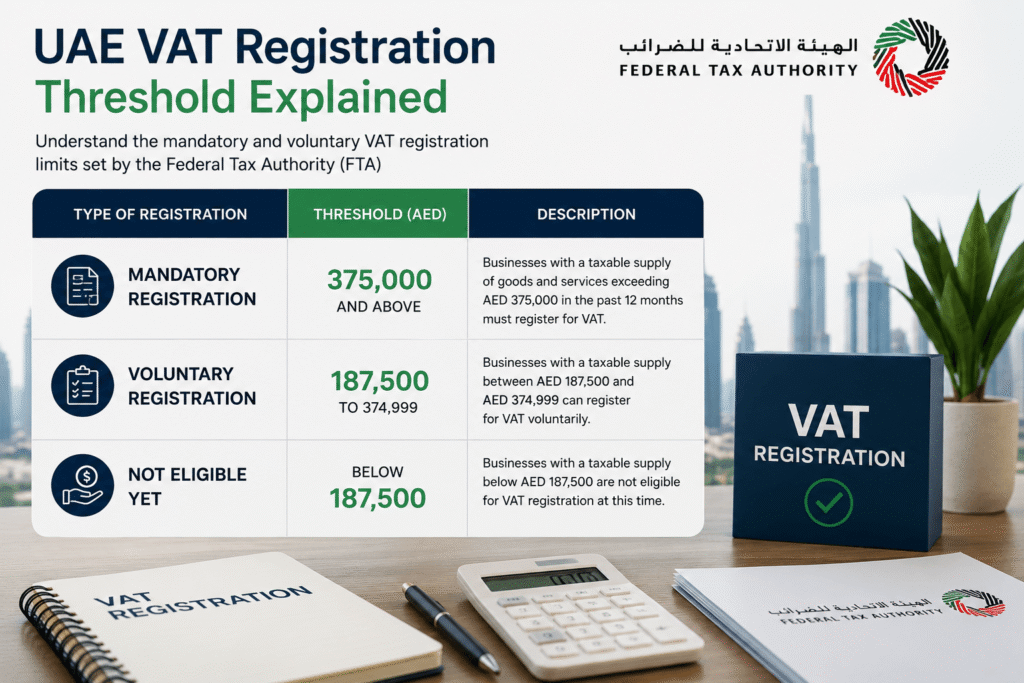
Understanding VAT registration UAE eligibility is the first real decision point for any business owner.
Mandatory Registration
A business must register for VAT if:
- Its taxable supplies and imports exceeded AED 375,000 over the previous 12 months, or
- It expects to exceed AED 375,000 in taxable supplies and imports within the next 30 days
This is the VAT registration threshold UAE authorities use to determine who is legally obligated to register. Per the FTA’s official terms and conditions, the registration application must be submitted within 30 days of becoming required to register, or a late registration penalty applies.
Voluntary Registration
A business can opt for voluntary registration if:
- Its taxable supplies, imports, or expenses exceeded AED 187,500 in the previous 12 months, or
- It expects to exceed this amount in the coming 30 days
Voluntary registration is popular among startups that want to reclaim VAT on setup costs — office rent, equipment, legal fees — even before they hit the mandatory threshold. We regularly see new e-commerce businesses in Dubai register voluntarily specifically to recover input VAT on inventory purchases during their first year.
Who Is Exempt
Businesses dealing exclusively in VAT-exempt supplies (such as certain financial services, residential real estate leasing, or bare land transactions) generally don’t need to register, though this depends heavily on the specific nature of the supply. It’s worth getting a proper assessment rather than assuming exemption applies.
For the official position on exemptions and taxable supply categories, refer to the Federal Tax Authority’s VAT guide.
What to Look For in a VAT Registration Partner
Not every provider handling your VAT registration Dubai filing offers the same level of care. Here’s how a basic provider typically compares to a top-tier accounting firm like Faucon IMC:
| Feature | Basic Provider | Top-Tier Firm (e.g. Faucon IMC) |
|---|---|---|
| Account management | Shared inbox, generic replies | Dedicated account manager assigned to your file |
| Threshold tracking | Client responsible for monitoring turnover | Proactive monitoring and threshold alerts |
| Cross-border expertise | UAE-only knowledge | Dual UAE-US tax expertise for foreign-owned entities |
| Documentation review | Basic checklist | Full pre-submission audit to avoid FTA rejections |
| Pricing | Hourly, unpredictable | Fixed-fee pricing agreed upfront |
| Post-registration support | None included | Ongoing bookkeeping, return filing, and CFO advisory |
VAT Registration Dubai: Step-by-Step Process
Dubai VAT registration online is done entirely through the FTA’s EmaraTax platform, the official e-services portal accessed via UAE Pass authentication. Here’s how the process typically unfolds.
Step 1: Create an EmaraTax Account
You’ll need to set up an account on the EmaraTax platform using your email and phone number. If your business already has a UAE Pass, you can link it for faster verification.
Step 2: Add Your Taxable Person Profile
This involves entering your trade license details, business activities, and legal entity type — LLC, sole establishment, civil company, branch, and so on.
Step 3: Complete the VAT Registration Application
This is where most of the detailed information goes in: turnover figures, expected taxable supplies, business relationships, customs registration details (if applicable), and bank account information.
Step 4: Upload Supporting Documents
The FTA requires several supporting documents, which we’ll detail below.
Step 5: Submit and Await FTA Review
Once submitted, the FTA VAT registration application is reviewed. If everything checks out, you’ll receive your Tax Registration Number (TRN) and VAT registration certificate Dubai businesses need for compliance. If there are gaps, the FTA will request clarification, which can extend the timeline.
Step 6: Receive Your VAT Certificate
The VAT registration certificate confirms your TRN, effective registration date, and tax period. Keep this on file — you’ll need it for contracts, tenders, and bank dealings.
Timeline Expectations
Most straightforward applications are processed within 20 business days, though complex cases — multiple business activities, group registrations, or free zone structuring — can take longer. Dubai customs VAT registration letter requests, needed for businesses involved in import-export activity, typically add extra verification steps since customs codes must be linked to your TRN. Our USA and UAE Tax Services team manages this end-to-end so nothing gets stuck in review.
Cost of VAT Registration in Dubai
One of the most common questions business owners ask is about the VAT registration Dubai fee. Here’s the honest breakdown.
FTA Government Fees
Registering directly with the FTA through EmaraTax costs nothing — there is no government fee for VAT registration itself. This surprises a lot of first-time applicants who assume it’s a paid government service like trade license renewal.
Professional Service Fees
Where cost actually comes in is if you engage VAT registration services in Dubai to handle the application on your behalf. Fees for professional VAT registration services Dubai firms charge typically range from AED 500 to AED 3,000, depending on:
- Complexity of your business structure
- Number of business activities
- Whether you need ongoing VAT return filing support bundled in
- Whether Dubai customs VAT registration is also required
Faucon IMC offers fixed-fee pricing on registration engagements, so there are no surprise invoices once the process starts.
Hidden Costs to Watch For
Some businesses underestimate the cost of getting it wrong. Incorrect classification of taxable supplies, missed deadlines, or inaccurate turnover reporting can trigger administrative penalties starting from AED 10,000 for late registration, plus ongoing compliance costs to fix the error. Paying for proper VAT registration services in Dubai upfront is often far cheaper than correcting mistakes later.

Legal Requirements in the UAE
VAT registration Dubai requirements are governed primarily by Federal Decree-Law No. 8 of 2017 on VAT and its executive regulations, along with updates issued by the FTA over time. If your business is also navigating corporate tax at the same time, our Corporate Tax Registration Deadline UAE guide covers that separate — and equally time-sensitive — obligation.
VAT Registration UAE Documents Required
To complete registration, businesses generally need:
- Valid trade license copy
- Passport and Emirates ID of the owner(s)/partners
- Memorandum of Association (MOA) or equivalent
- Contact details of the authorized signatory
- Bank account details (IBAN)
- Description of business activities
- Financial statements or turnover declaration for the past 12 months
- Customs registration details, if applicable, for Dubai trade VAT registration
- Lease agreement or proof of business address
Our Accounting Services team can help you prepare clean turnover records and financial statements ahead of submission.
Legal Obligations Post-Registration
Once registered, businesses are legally required to:
- Charge VAT on taxable supplies at the correct rate (0% or 5%)
- Issue tax invoices that comply with FTA formatting rules
- File VAT returns, usually quarterly, though some large businesses file monthly
- Maintain accounting records for a minimum of 5 years
- Pay any VAT due by the specified deadline
Group VAT Registration
Related companies under common ownership can apply for VAT group registration, which simplifies compliance by treating multiple entities as a single taxable person. This is common among holding company structures in Dubai with several subsidiaries.
Mainland vs Free Zone VAT Registration
A question we get asked constantly is whether mainland companies and free zone companies follow different VAT rules. The short answer is: the registration process itself is identical, but the tax treatment of certain transactions can differ.
Free zone companies located in what the FTA classifies as a “Designated Zone” — such as Jebel Ali Free Zone (JAFZA) or Dubai Airport Free Zone (DAFZA) — may qualify for special treatment on the movement of goods between Designated Zones, provided strict conditions around control, security, and customs procedures are met. Services, however, are generally treated the same regardless of zone.
Mainland companies don’t have this distinction. Every standard-rated supply is taxed at 5% unless it falls under a specific zero-rated or exempt category defined in the VAT law. This is why businesses that operate in both mainland and free zone structures — which is common in Dubai — should get proper guidance before assuming their free zone status automatically reduces VAT exposure. Our Business Setup Services team can advise on the right structure from the outset.
Mainland companies don’t have this distinction. Every standard-rated supply is taxed at 5% unless it falls under a specific zero-rated or exempt category defined in the VAT law. This is why businesses that operate in both mainland and free zone structures — which is common in Dubai — should get proper guidance before assuming their free zone status automatically reduces VAT exposure.
Amendments and Deregistration
VAT registration isn’t a one-time, “set and forget” event. Businesses are legally required to notify the FTA within 20 business days of any change to their registered details — a new trade license activity, a change in legal structure, or a change in business address, for example.
Similarly, if your business closes down, stops making taxable supplies, or falls below the voluntary threshold, you may need to apply for VAT deregistration. Failing to deregister when required carries its own penalties, so this step is just as important as the original registration — our VAT Deregistration UAE guide covers that process in full.
Best Practices for VAT Registration in Dubai
Register Before You Need To, Not After
If your business is trending toward the AED 375,000 threshold, don’t wait until you cross it. Start the registration process a few weeks ahead so you’re not scrambling to file once the deadline hits.
Keep Financial Records Clean From Day One
The FTA VAT registration process asks for turnover figures and forecasts. If your bookkeeping is messy, this step alone can delay your application by weeks. (As an illustrative example of a pattern we see often: a business in Business Bay once had to pause its application for nearly a month simply because its revenue records weren’t reconciled properly — this is a common scenario, not a named client.)
Use a Single, Consistent Business Activity Description
Vague or inconsistent descriptions of business activity across your trade license and VAT application often trigger FTA queries. Keep it specific and aligned with your actual license activities.
Get Professional Guidance for Complex Structures
If you operate across free zones and mainland, deal with international trade, or have multiple related entities, working with experienced VAT registration services in Dubai saves time and avoids classification errors that could affect your tax position for years.
Benefits of Proper VAT Registration
Getting VAT registration Dubai right isn’t just about avoiding penalties — it brings real operational advantages.
Credibility with clients and partners. A VAT registration certificate signals that your business is properly established and compliant, which matters when bidding for government tenders or corporate contracts.
Input VAT recovery. Registered businesses can reclaim VAT paid on eligible business expenses, which directly improves cash flow, especially for capital-intensive startups.
Smoother banking relationships. UAE banks increasingly request TRN details during account opening and periodic reviews. Having your VAT status sorted avoids friction.
Easier international trade. For businesses involved in Dubai trade VAT registration and cross-border transactions, being VAT-registered simplifies customs clearance and documentation with Dubai customs VAT registration letters.
Reduced audit risk. Businesses that register on time and file accurately are far less likely to attract detailed FTA audits compared to those with a history of late or incorrect filings.

Common Challenges Businesses Face
Misjudging the Threshold
Some businesses miscalculate their taxable supplies by excluding zero-rated or certain exempt items incorrectly, which throws off their threshold calculation entirely.
Incomplete Documentation
Missing or mismatched documents — like a trade license that doesn’t match the MOA details — is one of the top reasons applications get delayed or rejected.
Confusion Over Free Zone Rules
Not all free zones are treated the same for VAT purposes. Designated Zones have special treatment for certain goods transactions, and businesses often misunderstand how this affects their registration and reporting obligations.
Delayed Registration
Business owners sometimes assume there’s a grace period after crossing the threshold. There isn’t a meaningful one — the obligation to register applies from the point the threshold is met or expected to be met.
Poor Understanding of Post-Registration Duties
Registration is just the start. Many businesses register correctly but then struggle with ongoing return filing, record-keeping, and invoice formatting, which leads to penalties down the line even after a clean registration.
Expert Tips for a Smooth VAT Registration
- Reconcile your books before applying. Have at least 12 months of clean turnover data ready.
- Match every document exactly. Trade license, MOA, and bank details should be consistent across all submissions.
- Apply for a Dubai customs VAT registration letter early if you import or export goods, since customs linkage can take extra processing time.
- Set calendar reminders for your VAT return filing deadlines immediately after receiving your TRN.
- Don’t guess on classification. If you’re unsure whether your supplies are standard-rated, zero-rated, or exempt, get a professional opinion before submitting.
- Retain a soft copy of your VAT registration certificate Dubai authorities issue and store it alongside your trade license for easy access during audits or tenders.
FAQ Section
Who needs to register for UAE VAT?
Any business with taxable supplies and imports exceeding AED 375,000 in the past 12 months, or expected to exceed that in the next 30 days, must register. Businesses above AED 187,500 can register voluntarily.
How long does VAT registration Dubai take to process?
Most applications are processed within 20 business days, though incomplete submissions or complex structures can extend this timeline.
Is there a government fee to register for VAT UAE?
No, the FTA does not charge a fee for VAT registration through EmaraTax. Costs only apply if you use professional VAT registration services in Dubai.
What documents are needed for VAT registration UAE?
Typically a trade license, Emirates ID/passport copies, MOA, bank account details, turnover records, and business activity descriptions.
Can a free zone company register for VAT UAE?
Yes. Free zone companies are subject to the same VAT registration UAE eligibility rules as mainland companies, though Designated Zones have specific treatment for certain goods.
What happens if I don’t register on time?
Late registration can result in penalties starting from AED 10,000, along with potential backdated VAT liability and interest.
Do I need a separate Dubai customs VAT registration for import-export activity?
Yes, businesses involved in customs-related trade need to link their customs code to their TRN and may require a Dubai customs VAT registration letter from the FTA.
Can I register for VAT UAE myself, or do I need an agent?
You can register directly through EmaraTax, but many businesses use VAT registration services Dubai firms provide to avoid errors, especially for complex structures.
Conclusion
VAT registration Dubai is a legal obligation that touches nearly every serious business operating in the UAE, whether you’re a small trading company, a growing SME, or an established corporation. Understanding your VAT registration UAE eligibility, preparing the right documents, and following the FTA’s process carefully will save you from unnecessary penalties and administrative headaches down the road.
The businesses that handle this well are the ones that treat VAT registration as a standard part of setting up and running a compliant company — not an afterthought. Whether you register directly through EmaraTax or work with professional VAT registration services in Dubai, the goal is the same: get your TRN, stay compliant, and keep your business protected from avoidable risk. Faucon IMC has helped businesses across the UAE get this right the first time — and we can help you too.
Call To Action
Need help navigating VAT registration Dubai requirements, documents, or deadlines? Speak with our accounting and tax specialists at Faucon IMC today and get your business registered correctly, the first time.
- Email: info@fauconimc.com
- WhatsApp UAE: +971 50 791 7150
- WhatsApp USA: +1 (818) 723-6166
- Website: fauconimc.com